

01Sculpture · Court imagery
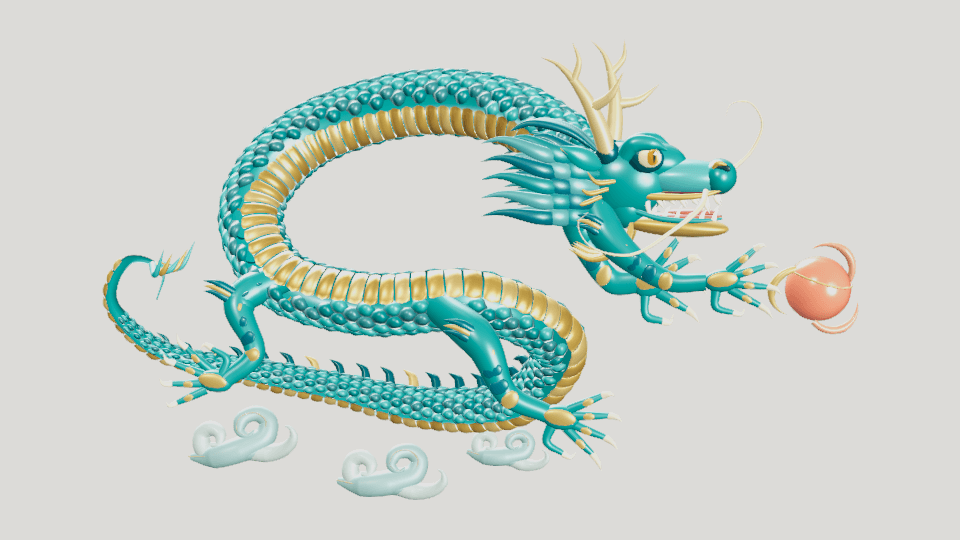
Follow the coil from its turquoise scales to the gold belly plates. The long whiskers and outstretched claws point toward the pearl.
Editorial collection
Begin with a dragon reaching for a pearl, then explore Yixing clay, Hainan weaving and Hong Kong’s double-decker trams.
Follow the coil from its turquoise scales to the gold belly plates. The long whiskers and outstretched claws point toward the pearl.
Look for the dragon in the open curve of a Hongshan jade carving and in the raised prow of a festival boat.
A long muzzle and swept-back mane interrupt a smooth, open curve. Turn the carving edge-on to see how thick the body is.
Look past the carved prow to the drum and paired paddling places. The long steering oar works from the stern.
Look for the part that holds each object together, from the loom’s warp to the stitches at the edge of a book.
The open warp meets a band of woven cloth. Look across the rods to follow the path of the shuttle.
A squat clay pot and two cups share a bamboo tea board. Follow the arch of the handle back into the pot.
A thin blue-and-white bowl stands beside the rough ceramic container that protected work during firing. Compare their rims and walls.
Follow the nested curves around to the back, where a fastening brings the three rings together.
Follow the sewing thread down the right edge. On the opposite side, the folded leaves catch the light.
Two beads sit above the reckoning beam and five below on each rod. Look along the frame to see how much room they have to travel.
See how a rod lifts a puppet, how a lion head rests on its dancer, and what holds a kite aloft.
Turn the instrument to follow its waist and see how the strings pass over the bridge.
Light passes through the cut leather. Turn the figure to see where the rods attach and which joints let the arms move.
The eyes and open mouth give the lion its expression. Orbit underneath to see the light frame a dancer carries.
Trace the forked tail and the sweep of the wings, then turn the kite over to see its bamboo frame.
Look inside a ship’s hull, below the soil of an oasis and across a terraced hillside.
One side of the wooden hull opens onto transverse bulkheads. Follow them across the keel to see how they divide the hold.
Follow the line of shafts to the sloping underground channel. Water emerges near the vines at the low end.
Follow water from the wooded ridge past a village into the curved rice terraces below. Each bank holds a different level.
Open a bamboo steamer, examine a butter-tea churn, then step out onto city rails.
Beside the woven lid, look for the closed pleats of har gow and the open tops of siu mai.
A long plunger fits into the tall wooden vessel. Look at the hoops that draw the wooden staves together.
Two rows of windows reveal the stacked passenger spaces. Follow the roof pole up and the rail wheels down.
The long nose flows into the driver’s windshield. Turn to the side to follow the line of passenger windows above the wheel assemblies.
Walk the Forbidden City’s courtyards, cross a mountain stream, then take a seat at the mahjong table.
Follow the central axis through the courtyards. Repeated roofs make each change of scale easier to see.
memeiii draws on Wudang landscapes in a scene of stone crossings, water and a red pavilion.
Rows of tiles and the spaces between seats give this familiar gathering its shape.
The original studies were made with Show3D Agent. Each links to a museum, heritage organization or local source. Three scenes by community creators bring their own interpretations of architecture, landscape and play.