
Skip to content
Show3D
  • Community
  • Pricing
Search scenes
Create
OverviewDocumentationTutorials & coursesSearch Learn
  • Overview
  • Get started with Show3D
  • Modeling tools
    • Modeling examples
  • Materials & textures
  • Agent modeling
    • Connect Codex
  • Asset generation

In this topic

  • Bridge loops
  • Fill a boundary
  • Delete faces
  • Dissolve an edge
  • Merge at center
  • Merge by distance
  • Separate geometry
  • Slide an edge
  • Slide a vertex
  • Recalculate normals
  • Mark sharp edges
  • Smooth shading
Browse documentation
  • Overview
  • Get started with Show3D
  • Modeling tools
    • Modeling examples
  • Materials & textures
  • Agent modeling
    • Connect Codex
  • Asset generation

In this topic

  • Bridge loops
  • Fill a boundary
  • Delete faces
  • Dissolve an edge
  • Merge at center
  • Merge by distance
  • Separate geometry
  • Slide an edge
  • Slide a vertex
  • Recalculate normals
  • Mark sharp edges
  • Smooth shading

Learn

Learn overviewDocumentationTutorials & coursesConnect Codex
XiaohongshuDouyinBilibili

Copyright © 2023 - 2026 Show3D Technology Limited. All rights reserved.

Terms of UsePrivacy Policy
Modeling tools
  1. Learn
  2. Documentation
  3. Modeling tools
  4. Fill a boundary

Fill a boundary

Create a face from a closed boundary. The boundary vertices stay fixed; the opening gains a surface.

Before you start

Enter Edit Mode. Select the vertices or edges around the opening you want to close; a simple, approximately planar boundary is a useful starting point.

Use the operation

Create a missing face across a boundary, or create an edge between two vertices.

  1. Switch to Vertex or Edge Select and select the intended boundary. Check that hidden or distant components are not included.
  2. Press F or choose Fill from the selection’s context menu.
  3. Inspect the new face from both sides. For a large or concave face, add deliberate internal edges if later deformation needs them.

Controls and choices

ControlsWhat changes
Two verticesA two-vertex selection can create an edge. A surface requires a suitable boundary with at least three corners.
One openingFill closes a boundary. Use Bridge Edge Loops when the goal is to connect two openings.
Face shapeA filled n-gon is not automatically a regular quad grid. Non-planar or concave outlines need closer inspection.

See what changes

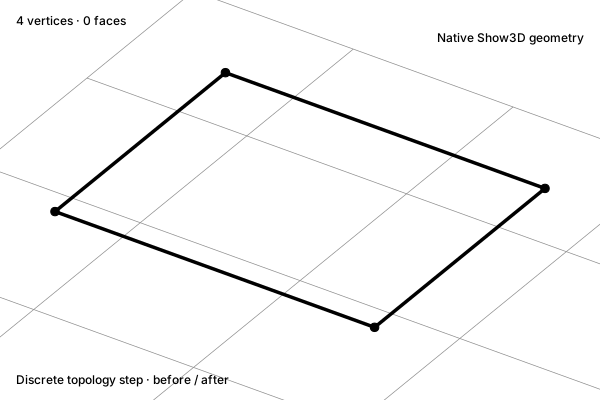
Before

Fill a boundary: An open boundary

An open boundary

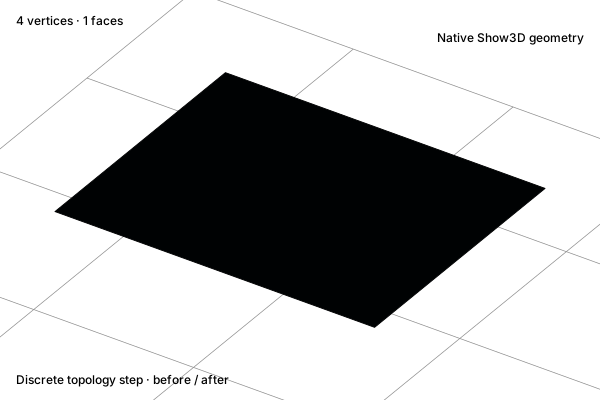
After

Fill a boundary: A filled face

A filled face

Concept illustration. The diagrams explain the operation. Your result depends on the starting geometry and settings.

Check the result

Confirm the opening is closed without a second overlapping face. Inspect shading and normals, then use Connect or Triangulate if the face needs explicit internal topology.

Related operations

Bridge loopsConnect verticesTriangulateRecalculate normals

Practice in Show3D

Open the editor and follow the steps with your own scene.
Start modelingModeling essentials

On this page

Before you startUse the operationControls and choicesSee what changesCheck the resultRelated operations