
Skip to content
Show3D
  • Community
  • Pricing
Search scenes
Create
OverviewDocumentationTutorials & coursesSearch Learn
  • Overview
  • Get started with Show3D
  • Modeling tools
    • Modeling examples
  • Materials & textures
  • Agent modeling
    • Connect Codex
  • Asset generation

In this topic

  • Bridge loops
  • Fill a boundary
  • Delete faces
  • Dissolve an edge
  • Merge at center
  • Merge by distance
  • Separate geometry
  • Slide an edge
  • Slide a vertex
  • Recalculate normals
  • Mark sharp edges
  • Smooth shading
Browse documentation
  • Overview
  • Get started with Show3D
  • Modeling tools
    • Modeling examples
  • Materials & textures
  • Agent modeling
    • Connect Codex
  • Asset generation

In this topic

  • Bridge loops
  • Fill a boundary
  • Delete faces
  • Dissolve an edge
  • Merge at center
  • Merge by distance
  • Separate geometry
  • Slide an edge
  • Slide a vertex
  • Recalculate normals
  • Mark sharp edges
  • Smooth shading

Learn

Learn overviewDocumentationTutorials & coursesConnect Codex
XiaohongshuDouyinBilibili

Copyright © 2023 - 2026 Show3D Technology Limited. All rights reserved.

Terms of UsePrivacy Policy
Modeling tools
  1. Learn
  2. Documentation
  3. Modeling tools
  4. Smooth shading

Smooth shading

Smooth the surface shading without adding vertices or rounding the silhouette. Use Subdivision Surface when the geometry itself needs smoothing.

Before you start

Return to Object Mode and select an editable mesh. Smooth shading changes how light is interpolated across faces; it does not increase mesh resolution.

Use the operation

Make a curved object shade smoothly while retaining its existing geometry.

  1. Select the mesh and open its object context menu.
  2. Choose Shade Smooth and inspect the surface from several viewing angles.
  3. If a corner needs a hard break, mark its edges sharp in Edit Mode. Choose Shade Flat in Object Mode to return to faceted shading.

Controls and choices

ControlsWhat changes
Shade SmoothSmooths the appearance of lighting across eligible boundaries. The silhouette keeps the same polygon edges.
Shade FlatDisplays each face with a distinct normal, which helps inspect faceted forms.
Subdivision SurfaceUse subdivision when you need additional geometry and a smoother silhouette. It solves a different problem from shading.

See what changes

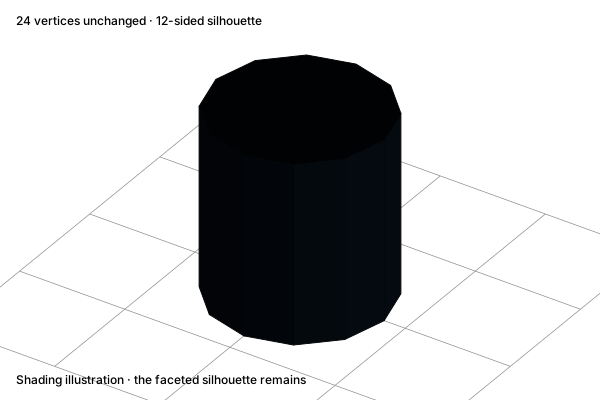
Before

Smooth shading: Flat face shading

Flat face shading

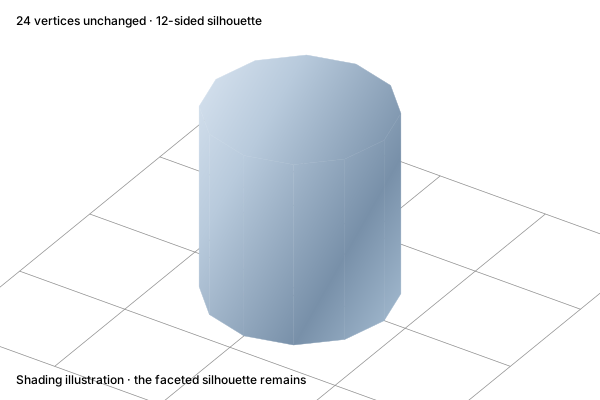
After

Smooth shading: Interpolated shading

Interpolated shading

Concept illustration. The diagrams explain the operation. Your result depends on the starting geometry and settings.

Check the result

Look for unwanted gradients on broad flat faces and hard breaks on curved areas. Correct sharp edges or normals before adding unnecessary geometry.

Related operations

Mark sharp edgesRecalculate normalsSubdivision Surface

Practice in Show3D

Open the editor and follow the steps with your own scene.
Start modelingModeling essentials

On this page

Before you startUse the operationControls and choicesSee what changesCheck the resultRelated operations