
Skip to content
Show3D
  • Community
  • Pricing
Search scenes
Create
OverviewDocumentationTutorials & coursesSearch Learn
  • Overview
  • Get started with Show3D
  • Modeling tools
    • Modeling examples
  • Materials & textures
  • Agent modeling
    • Connect Codex
  • Asset generation

In this topic

  • Add a primitive
  • Move
  • Rotate
  • Scale
  • Duplicate
  • Repeat in a line
  • Repeat around a center
  • Snap to a grid
  • Align vertices
  • Group objects
  • Join meshes
  • Set the origin
  • Apply transforms
Browse documentation
  • Overview
  • Get started with Show3D
  • Modeling tools
    • Modeling examples
  • Materials & textures
  • Agent modeling
    • Connect Codex
  • Asset generation

In this topic

  • Add a primitive
  • Move
  • Rotate
  • Scale
  • Duplicate
  • Repeat in a line
  • Repeat around a center
  • Snap to a grid
  • Align vertices
  • Group objects
  • Join meshes
  • Set the origin
  • Apply transforms

Learn

Learn overviewDocumentationTutorials & coursesConnect Codex
XiaohongshuDouyinBilibili

Copyright © 2023 - 2026 Show3D Technology Limited. All rights reserved.

Terms of UsePrivacy Policy
Modeling tools
  1. Learn
  2. Documentation
  3. Modeling tools
  4. Group objects

Group objects

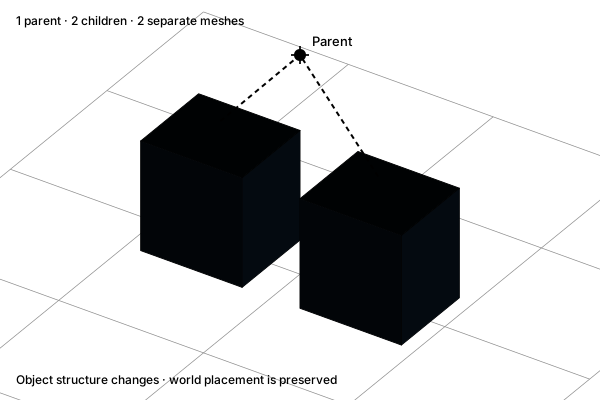
Organize objects under a parent while preserving separate meshes. Moving the group can move the assembly together.

Before you start

Select the objects that form an assembly in object mode. A group is a parent in the scene hierarchy; its children retain their own geometry and materials.

Use the operation

Keep related parts organized and transform them together.

  1. Select the parts and choose Group from the object context menu.
  2. Locate the new group in the scene tree and give it a useful assembly name.
  3. Select the group to move, rotate, or scale the assembly. Select a child when only one part should change.
  4. Use Ungroup when the hierarchy is no longer useful, then check that the parts retain their intended placement.

Controls and choices

ControlsWhat changes
Parent selectionTransforms applied to the group affect its descendants.
Child selectionEdits a part independently within the parent's coordinate system.
Lock stateA locked object or ancestor can make an operation unavailable. Inspect the scene tree if a group cannot be edited.

See what changes

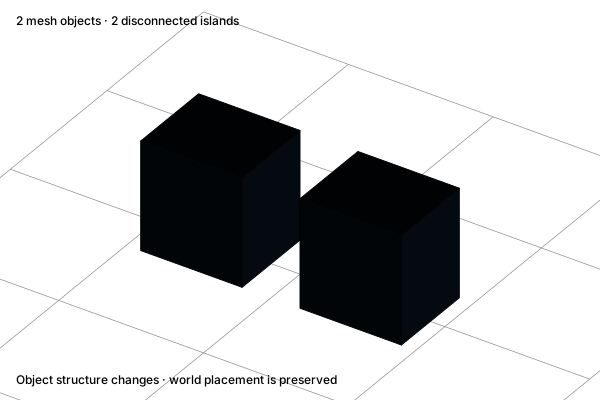
Before

Group objects: Two separate objects

Two separate objects

After

Group objects: One parent, two children

One parent, two children

Concept illustration. The diagrams explain the operation. Your result depends on the starting geometry and settings.

Check the result

Expand the group to confirm its members. Grouping should not change mesh topology or fuse touching parts. Avoid selecting both a parent and its descendant when preparing another grouping operation; select the intended hierarchy level.

Related operations

MoveDuplicateJoin meshes

Practice in Show3D

Open the editor and follow the steps with your own scene.
Start modelingModeling essentials

On this page

Before you startUse the operationControls and choicesSee what changesCheck the resultRelated operations