

Set the origin
Move the object’s origin to its geometry center while preserving the world-space position of every vertex.
Before you start
Select a mesh in object mode. Use Reset Origin when its pivot should be at the center of its geometry bounds. The current command recenters the origin; it does not provide an arbitrary pivot-placement dialog.
Use the operation
Recenter the pivot before rotating or scaling a part.
- Select the mesh and inspect the position of its transform gizmo relative to the visible geometry.
- Choose Reset Origin from the object context menu.
- Confirm that the origin moves to the center of the mesh's local geometry bounds while the visible geometry stays in place.
- Try a small rotation to check the new pivot, then undo that rotation if it was only a positioning check.
Controls and choices
| Controls | What changes |
|---|---|
| Geometry bounds | The command uses the local bounding-box center, which can differ from the center of mass or a visually preferred hinge point. |
| Object position | The position compensates for the geometry offset so the visible mesh retains its world placement. |
| Apply transforms | Baking transforms is a different operation. Choose it only when you also need to normalize transform values. |
See what changes
Before
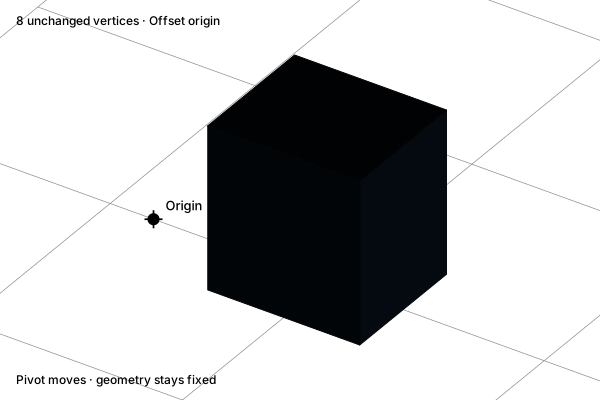
An offset pivot
After
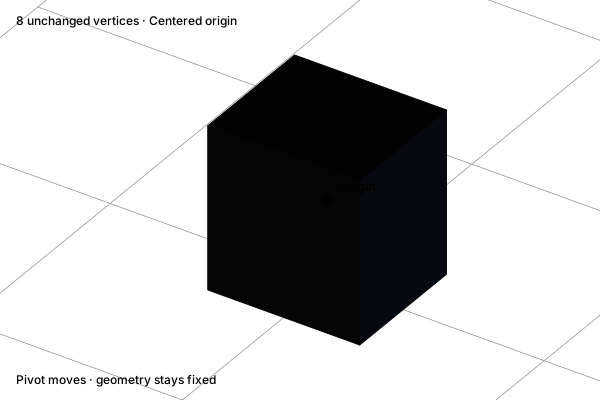
Pivot at the geometry center
Check the result
Check that the mesh did not visibly shift and that the new pivot is useful for the next transform. A long protrusion can pull the bounding-box center away from the main body. For a hinge or a shared assembly center, a parent group can provide a more suitable transform context.
Practice in Show3D
Open the editor and follow the steps with your own scene.