

Move
Translate the object along an axis. Its shape, dimensions, and topology stay the same.
Before you start
Select the object you want to position. Use object mode to move the whole object; mesh edit mode transforms only the selected components. For an assembly, select its group to move the parts together.
Use the operation
Position a part along a controlled direction.
- Choose Move from Transform Mode in the toolbar. The displayed shortcut is W when the workspace has focus.
- Choose World for scene-aligned axes or Local for the object's own axes, then drag the required axis handle.
- For numeric placement of one object, edit Position X, Y, or Z in its properties. These are object coordinates relative to its parent.
- Check the clearance from adjacent parts in another view before continuing.
Controls and choices
| Controls | What changes |
|---|---|
| World / Local | Chooses the orientation of the transform handles. A rotated object can have local axes that differ from the scene axes. |
| Position X / Y / Z | Numeric coordinates for the selected object. A transformed parent affects the resulting world position. |
| Snap | Constrains a move to the enabled targets; choose the target and snap base before dragging. |
See what changes
Before
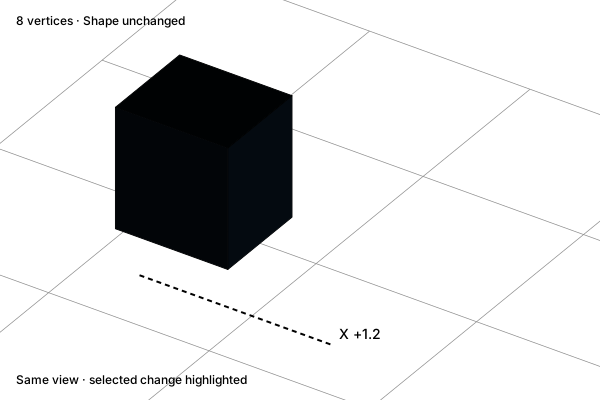
Original position
After
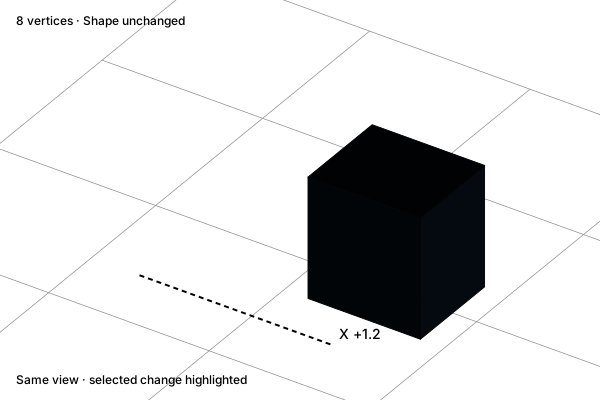
Moved on one axis
Check the result
The silhouette and dimensions should remain unchanged. If only part of the mesh moves, inspect the edit mode and component selection. If the object moves in an unexpected direction, check World/Local and its parent transform.
Practice in Show3D
Open the editor and follow the steps with your own scene.