

Rotate
Rotate the object about its pivot. Vertex distances from that pivot are preserved.
Before you start
Select an object in object mode and locate its transform pivot. Rotation uses that pivot, so a distant origin can make the object travel around a large circle.
Use the operation
Orient a part without changing its proportions.
- Choose Rotate in Transform Mode; the displayed shortcut is E when the workspace has focus.
- Choose World or Local and drag the ring for the required axis.
- For a known angle on one object, edit Rotation in its properties. The interface shows degrees.
- Inspect the result from a second view and check connections to neighboring parts.
Controls and choices
| Controls | What changes |
|---|---|
| Rotation X / Y / Z | Sets orientation in degrees relative to the parent. Multiple axis rotations interact; change one at a time when diagnosing a result. |
| Transform space | World follows scene axes; Local follows the selected object's orientation. |
| Origin | Affects the center of object rotation. Reset Origin can recenter a mesh on its geometry bounds. |
See what changes
Before
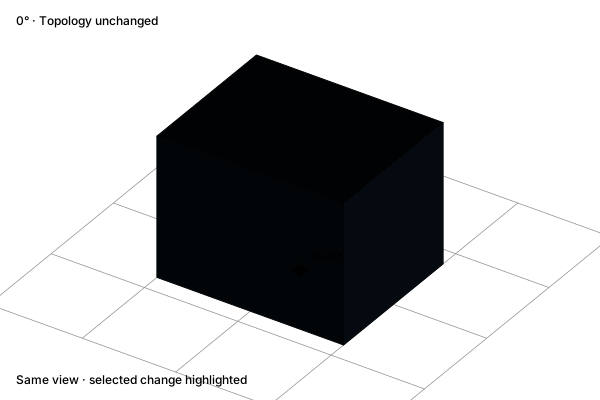
Original orientation
After
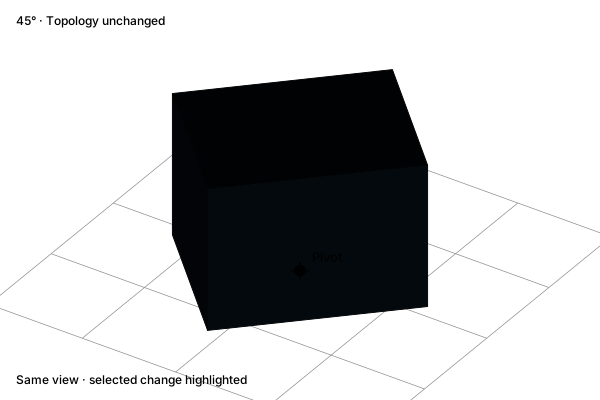
Turned about the pivot
Check the result
Distances within the object should remain unchanged. If rotation makes the part swing away from its intended location, check the pivot before compensating with extra moves. Inspect parent transforms if numeric rotation does not match the apparent world orientation.
Practice in Show3D
Open the editor and follow the steps with your own scene.