
Skip to content
Show3D
  • Community
  • Pricing
Search scenes
Create
OverviewDocumentationTutorials & coursesSearch Learn
  • Overview
  • Get started with Show3D
  • Modeling tools
    • Modeling examples
  • Materials & textures
  • Agent modeling
    • Connect Codex
  • Asset generation

In this topic

  • Extrude
  • Bevel
  • Select components
  • Select a loop
  • Extrude a vertex
  • Extrude an edge
  • Inset a region
  • Inset individual faces
  • Bevel a vertex
  • Loop cut
  • Knife cut
  • Connect vertices
  • Subdivide a mesh
  • Triangulate
  • Triangles to quads
Browse documentation
  • Overview
  • Get started with Show3D
  • Modeling tools
    • Modeling examples
  • Materials & textures
  • Agent modeling
    • Connect Codex
  • Asset generation

In this topic

  • Extrude
  • Bevel
  • Select components
  • Select a loop
  • Extrude a vertex
  • Extrude an edge
  • Inset a region
  • Inset individual faces
  • Bevel a vertex
  • Loop cut
  • Knife cut
  • Connect vertices
  • Subdivide a mesh
  • Triangulate
  • Triangles to quads

Learn

Learn overviewDocumentationTutorials & coursesConnect Codex
XiaohongshuDouyinBilibili

Copyright © 2023 - 2026 Show3D Technology Limited. All rights reserved.

Terms of UsePrivacy Policy
Modeling tools
  1. Learn
  2. Documentation
  3. Modeling tools
  4. Triangles to quads

Triangles to quads

Merge a suitable adjacent triangle pair into a quad. Matching topology and surface conditions determine which pairs can be combined.

Before you start

Use Face Select in mesh edit mode and select neighboring triangles. Conversion needs suitable adjacent pairs; it is not automatic retopology for an arbitrary generated mesh.

Use the operation

Replace suitable triangle pairs with easier-to-edit quads.

  1. Start with a small area of adjacent triangles whose shared diagonals you want to remove.
  2. Choose Tris to Quads from the face context menu.
  3. Inspect which pairs were combined and which triangles remain.
  4. Continue region by region, using manual connections or dissolves where automatic pairing is unsuitable.

Controls and choices

ControlsWhat changes
Adjacent pairsTwo triangles must share suitable topology to form one usable quad.
Surface compatibilityGeometry and surface conditions influence which pairs can be joined. A remaining triangle is not necessarily an error.

See what changes

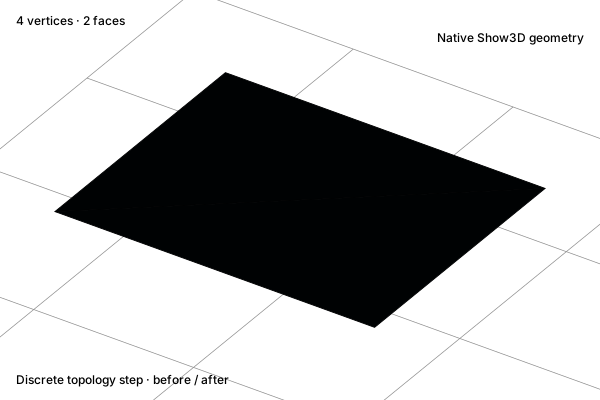
Before

Triangles to quads: A triangle pair

A triangle pair

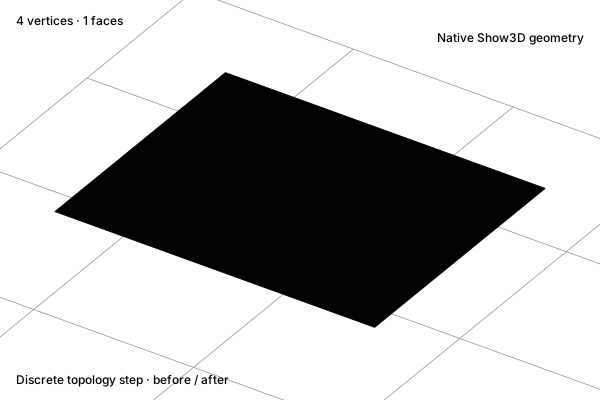
After

Triangles to quads: One quad

One quad

Concept illustration. The diagrams explain the operation. Your result depends on the starting geometry and settings.

Check the result

Look for regular edge flow and quads that follow the intended shape. A four-sided face can still be stretched or non-planar. Do not repeat the command expecting every triangle to disappear; use deliberate topology editing or remeshing for a different overall structure.

Related operations

TriangulateDissolve an edgeConnect verticesRemesh

Practice in Show3D

Open the editor and follow the steps with your own scene.
Start modelingModeling essentials

On this page

Before you startUse the operationControls and choicesSee what changesCheck the resultRelated operations